
Can I Actually Visit the Shop and See My Cabinets Being Built?
Custom Cabinetry · South Florida · Since 2002
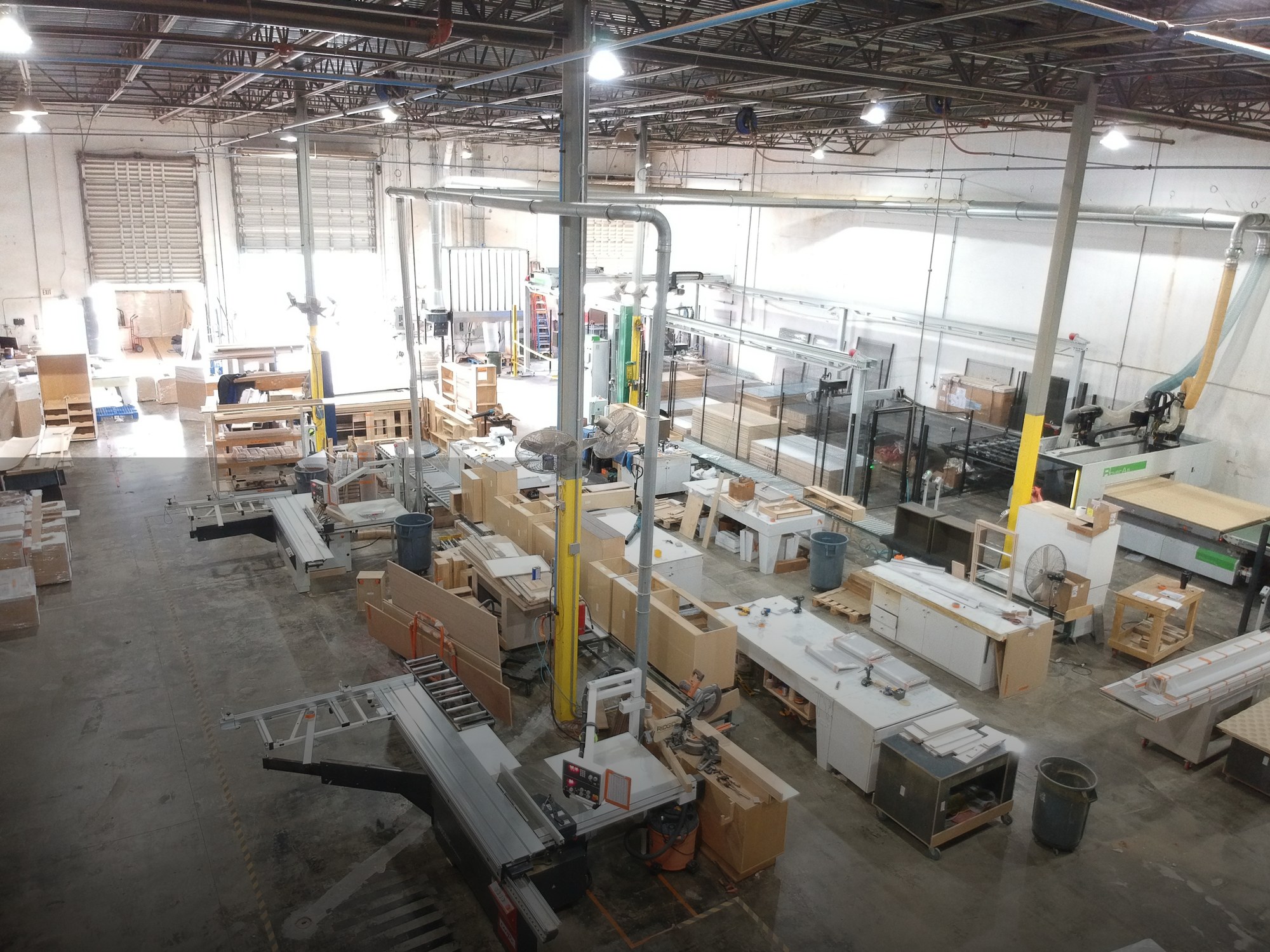
Yes. By appointment, with a safety vest and goggles, and most people who do it become clients.
That last part isn’t a sales line. It’s the most reliable pattern we’ve seen in more than two decades: when someone walks our factory floor, the conversation changes. They stop asking whether we can build their kitchen and start asking how quickly we can do it.
The Direct Answer
We encourage it. Our salespeople are expected to bring builders, designers, architects, developers, and homeowners onto the floor, because a showroom can only tell you so much. A beautiful showroom in Boca Raton has a sales rep in it, maybe two, and a secretary. That is not evidence of anything. Anyone can rent a showroom.
The factory is different. Walk in and you’re in the office first — roughly 2,500 square feet with seven engineers drawing kitchens, the accounting office, the sample library, sales staff working with builders. Then you go through one door and the shop floor opens up behind it. Nineteen people, in one location, making cabinets. A Biesse Rover A router, fed by a Winstore X3 panel-storage system. A Biesse Stream A Smart edge bander, immediately to the right as you come through. Italian machines, and you can watch them run.
Nobody has ever walked through that door and told us the shop looked small.
The Story: A Developer, Recently
A spec developer came through not long ago. He’d been doing what anyone should do — collecting quotes, comparing portfolios, deciding who to trust with a large order.
He walked the office. He walked the shop floor. Then we walked him over to the new facility, where the machines are already in place. He went quiet. When he spoke again, he congratulated us on the scale of the operation, and the questions he’d arrived with were gone. He wasn’t asking whether we could handle his project anymore. He was asking about capacity and turnaround.
That is the entire mechanism of a factory visit, and it is the pattern we see most.
The Mechanism: Why a Working Floor Persuades and a Portfolio Doesn’t
A portfolio is a photograph of an outcome. It proves someone, somewhere, once built a beautiful kitchen. It cannot tell you who built it, whether they still work there, or whether the company will exist when a door needs adjusting in year three.
A working factory answers all three at once, without anyone making a claim. You see the machines. You see the people. You see material moving. You see cabinets in progress that belong to somebody else’s house — which is the clearest possible evidence that yours will be built the same way.
For builders, the read is capacity. They look at the equipment and the floor and understand they have a partner who can grow with their business rather than a shop that will become a bottleneck.
For designers, it’s the finish. When you can see finishing handled inside one production line rather than farmed out or sprayed on a job site, custom color and stain stop being a risk you have to manage on behalf of your client. That changes how you specify.
What’s Coming Online
We’re moving into a 24,000-square-foot climate-controlled facility over the next few months. Today’s shop is about 10,000 square feet of production plus 2,000 of office, and it is not climate-controlled. The new plant is.
The machines are already in. Two Biesse routers, both larger than the Rover A we run today, against the single router currently operational. Winstore panel-storage capacity goes from 800 sheets to 3,000. And the finishing line — an inline sander, an automatic sprayer, a dry line, and an oven that cures the finish — sits where you first come through the back door, so it’s the first thing a visitor sees.
Climate control is the part that matters most in South Florida, and it is the part nobody puts in a photograph. A finish cured in conditioned air is stable before it ever leaves the building.
The Mistake: Treating a Catalog and a Factory as the Same Purchase
There is nothing wrong with the large out-of-state and overseas manufacturers. They exist for a reason and they serve their customers. If you buy from a catalog through a dealer, you will likely get a decent cabinet.
What you will not get is a floor to walk. You will not get the ability to call in the middle of a build and come see your own boxes. And if something goes wrong in year four, you will be working through a middleman to reach a factory you have never seen, in a state or a country you have never visited.
That is a different purchase from the one people think they’re making. It’s worth knowing which one you’re making.
The Tell: What to Ask Any Cabinet Shop
Ask this: “Can I come see my cabinets being built?”
Then listen to the shape of the answer. A shop that manufactures will say yes and immediately start talking about scheduling and safety, because those are the real constraints. A shop that outsources will talk about the showroom, the portfolio, the process, the relationship. All fine words. None of them are a floor.
The follow-up worth asking: “What will I see when I walk in?” A manufacturer can describe the route through the building from memory.
What Builders, Designers, and Architects Should Know
About 80 percent of our work now comes from builders, designers, architects, and developers. The other 20 percent is homeowners. Everyone gets the same cabinet. The same 3/4″ case, the same dovetailed solid-maple drawer boxes or Blum LEGRABOX, the same Blum hardware, the same soft-close full-extension on every door and drawer. A homeowner’s bar unit is built the way a developer’s multifamily package is built. You can specify it either way.
The reason to bring your client to the floor is not that it flatters us. It’s that it settles the question of who is actually making the thing, which protects your specification and your relationship when the job gets complicated.
The Sunshine Alliance Standard
We started in 2002 in a 400-square-foot shop. More than two decades later, everything is still drawn, engineered, built, and installed by us.
The visit is by appointment for one reason: forklifts are running, material is moving, and heavy machinery is in operation. When you come, you get a vest and goggles, and our operators slow the floor down so they can see you and work around you. That is not hospitality theater. It’s what it costs to walk through a factory that is actually running.
And if you’re ever second-guessing whether your cabinets are being built the way you specified — come in. Look at them. Touch them. We’re not going anywhere.
Related from the Journal
Frequently Asked Questions
Can I actually visit the shop and see my cabinets being built?
Why is the factory visit by appointment instead of open to walk-ins?
Why does seeing the factory matter more than seeing a portfolio?
What should I ask a cabinet shop that says it builds custom cabinets?
